Start with The Making of a Manager by Julie Zhuo, then read The First 90 Days before your first round of one-on-ones. Read the other books for first-time managers when their problem arrives: feedback in weeks two to four, the first hard conversation in month two, then delegating, then building a team that tells you the truth.
This list is for people promoted out of an individual role, the engineer, PM or consultant who was good at the work and now runs it, often with former peers as reports. Each stretch of the first 90 days gets one book per problem and one thing to try that week. You'll also get questions for your first one-on-ones, a five-line agenda, the two hard-conversation books side by side, and a week-by-week plan. These are also the books for first-time supervisors and team leads: the job title differs, the problems don't.
If you read one book first: The Making of a Manager
Read The Making of a Manager first because it's written from the seat you're in. Zhuo became a manager at 25, during a 14-year run at Facebook that took her from its first intern to vice president of product design. The book describes the first years of managing as they feel at the time, not as a senior executive remembers them.
Her definition of the job is the one to keep: a manager's job is to get better outcomes from a group of people working together. Your own brilliant work now counts only as far as it lifts the team's results.
Zhuo gives you three levers to check when something goes wrong. Purpose is why the team exists and what success looks like. People is who does the work and whether they're set up for it. Process is how the work gets done together.
She also names four ways into the job. The Apprentice is promoted from inside the team and now manages former peers. The Pioneer starts a new team, the New Boss arrives from outside, and the Successor takes over a team someone else built. Work out which one you are, because each has its own traps.
Skip it if you've managed for a few years already; most of it will feel familiar.
Try this week: write two sentences on what your team is for and what success looks like at the end of the quarter. Show them to your boss and ask what you got wrong.
If you're a founder hiring your first reports, our reading list for startup founders puts three of these books in its build-the-team stage.
Weeks 1–2: learn the team before you change it
The pull in the first two weeks is to fix things, usually by doing the work you were promoted for. The First 90 Days by Michael D. Watkins argues against it. His first piece of advice is to promote yourself: make a mental break from the old job, and stop doing work your team should now own.
Watkins also asks you to read the situation before acting. His STARS model sorts teams into start-up, turnaround, accelerated growth, realignment and sustaining success. A move that rescues a turnaround can damage a team that's already working, so if yours mostly works, protect what works before you change anything.
Two more ideas belong in week one. Ask your own boss early how they see the situation and what they expect from you; Watkins lays out five conversations to have with a new boss. And look for an early win the team will notice, chosen to build trust in you as their manager, not to prove you can still do the old job.
Skip it if you've been in the role for more than a few months; it's built around the transition itself.
Five questions for your first one-on-one with each person
Ask them in this order, take notes, and promise nothing yet.
- What's working on this team that I should protect?
- What's slowing you down that I might be able to remove?
- What did your last manager do that you'd like me to keep doing, and what should I stop?
- How do you like to get feedback: in the moment, in writing, or saved for our one-on-one?
- Where do you want to be in a year or two, and what would help you get there?
If this person was your peer a month ago, add one more before you finish: "What should change between us now, and what shouldn't?" Saying the awkward part out loud early is easier than both of you guessing for months.
Weeks 2–4: one-on-ones and feedback
By week three you'll have feedback to give and some coming back. Read one book for each direction.
Giving feedback: Radical Candor
Radical Candor by Kim Scott, who led teams at Google and later taught at Apple University, puts feedback on two axes. One is how much you show you care about the person. The other is how willing you are to challenge them directly. The goal is both at once.
Care without challenge is what Scott calls ruinous empathy, and she says it's the most common mistake bosses make. It's hardest to avoid with a former peer, because staying liked feels like keeping the friendship. Scott also advises asking for criticism before handing much of it out, so the team sees you can take what you give.
Skip it if you already give specific feedback every week and get it back; reread the chapter on asking for criticism instead.
Try this week: within a day of each event, give one piece of specific praise and one specific correction, in person, about the work and not the person.
Hearing feedback: Thanks for the Feedback
Thanks for the Feedback by Douglas Stone and Sheila Heen covers the other side of the table. Feedback stings, they argue, when it sets off a trigger: we think it's wrong, we don't trust the person giving it, or it shakes how we see ourselves. Naming which one fired lets you hear what's left.
Skip it if feedback rarely bothers you.
Try this week: end each one-on-one with the same question: what's one thing I'm doing, or not doing, that gets in your way? Write the answer down and say thanks. Don't defend yourself in the moment.
A one-on-one agenda in five lines
Zhuo is firm that the one-on-one belongs to the report, so keep this in a shared doc they fill in first.
- Their topics, added before the meeting, discussed first
- One thing that went well since last time
- What's blocked, and what I can do about it
- Feedback both ways: one note from me, one for me
- Next steps with names and dates, plus one step toward the goal they named in week one
Month 2: the first hard conversation
Somewhere in month two a deadline slips twice, or a former peer takes your promotion badly. Two books cover this, and they solve different problems.
Crucial Conversations, by Kerry Patterson, Joseph Grenny, Ron McMillan and Al Switzler, is about talks where the stakes are high, opinions differ and feelings run strong. Difficult Conversations, by Douglas Stone, Bruce Patton and Sheila Heen, is about talks where you don't even agree on what happened.
| Crucial Conversations | Difficult Conversations | |
|---|---|---|
| Best for | A behavior that keeps repeating: missed commitments, a broken agreement | A talk full of hurt or blame: a peer upset by your promotion, a disputed rating |
| Core idea, in our words | People who feel unsafe go quiet or attack. Keep it safe so more facts reach the table before anyone decides | Every hard talk is three talks: what happened, how we feel, and what it says about us. Ask how each of you contributed instead of whose fault it was |
| Read it when | You need an agreement and a follow-up by the end of the talk | They need to feel heard before anything can change |
| Try this | Open with the facts you saw, then your interpretation, then ask for theirs | Open with the "third story": the disagreement as a neutral observer would put it |
If you only have time for one, read Difficult Conversations when the problem is the relationship, and Crucial Conversations when the problem is a behavior.
Months 2–3: delegating without disappearing
New managers tend to hold on to every decision or hand everything off and vanish. Both books here aim at the middle.
Multipliers by Liz Wiseman sorts leaders into Multipliers, who make the people around them smarter and more capable, and Diminishers, who drain them. The useful idea for a new manager is the accidental diminisher: a well-meaning boss who rescues every struggling task or answers every question first, and so teaches the team to wait. It's an easy trap for anyone promoted for being the person who fixes things.
Skip it if your team already brings you answers along with the problems.
Try this week: hand one decision you'd normally make to the person closest to the work. Give them the outcome you need and the constraints, not the steps. In your next team meeting, ask a hard question instead of supplying the answer.
Extreme Ownership by Jocko Willink and Leif Babin, both former Navy SEAL officers, starts from the other end: the leader owns everything that happens on their team, including failures they didn't cause. For delegation, the chapter to read is on decentralized command. People can act on their own only when they understand why the work matters, so a leader's main job is explaining the intent clearly enough that nobody has to ask.
Skip it if war stories put you off; the ideas travel, but the book teaches through combat in Iraq.
Try this week: before you delegate, write the task's purpose in one sentence the other person could repeat back. If they can't, the brief isn't finished.
Month 3: a team that tells you the truth
By month three your team has learned whether it's safe to disagree with you. The last three books are about making the answer yes.
The Fearless Organization by Amy Edmondson is the research-backed version. In her 1999 paper in Administrative Science Quarterly, Edmondson defined team psychological safety as a shared belief that the team is safe for interpersonal risk taking.
In a study of 51 work teams at one manufacturing company, psychological safety was associated with learning behavior, such as asking questions, seeking feedback, experimenting and discussing mistakes, and that learning behavior was linked to team performance. It's one company and a field study of associations, so it can't show that safety causes better results on its own. In the book, Edmondson recalls a hospital study where the better-run units seemed to report more medication errors, likely because people there felt able to admit them.
Google's own team research pointed the same way. Project Aristotle studied 180 Google teams, 115 in engineering and 65 in sales, and ranked five dynamics of effective teams in order of importance. Psychological safety came first. Dependability, structure and clarity, meaning, and impact followed.
Skip it if you want scripts more than research; Radical Candor is more hands-on.
Try this week: in your next team meeting, name one thing you got wrong this month and ask what you're missing. Thank whoever answers, especially if the answer stings.
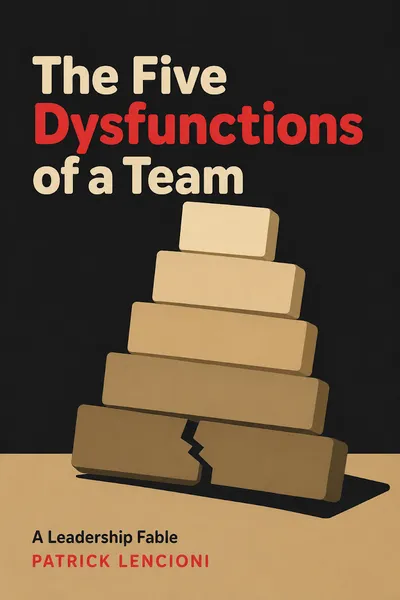
The Five Dysfunctions of a Team by Patrick Lencioni is a business fable about a new CEO taking over a talented executive team that can't get anything done. Its model stacks five problems, from absence of trust at the bottom, through fear of conflict, lack of commitment and avoidance of accountability, to inattention to results at the top. Read it for the order: a team without trust won't argue honestly, and a team that doesn't argue won't truly commit. Skip it if you dislike fables; the model is laid out plainly in the last part of the book.
Dare to Lead by Brené Brown is about the nerve the other books assume: saying the uncomfortable thing and staying for the reply. Her line "Clear is kind. Unclear is unkind." is the shortest management advice on this list, and it pairs well with Radical Candor. Skip it if you prefer process to reflection; this is the most personal book here.
The best books on leadership for new managers, mapped to Google's research
Google's Project Oxygen was a multi-year study that analyzed more than 10,000 data points from performance reviews and feedback surveys, plus hundreds of pages of interview notes. It found that teams with highly effective managers were more likely to get better results, be happier and have lower turnover. The study covered one company's managers, so treat its ten behaviors as a well-tested checklist, not a universal law.
We matched each behavior to the book on this list that teaches it most directly. Google's exact wording is on the re:Work page; two rows are lightly reworded.
| Behavior (Google's list) | Book that teaches it | When in this plan |
|---|---|---|
| Be a good coach | The Making of a Manager, Radical Candor | Weeks 1–4 |
| Give the team room without micromanaging | Multipliers, Extreme Ownership | Months 2–3 |
| Create a team environment that values everyone | The Fearless Organization, Dare to Lead | Month 3 |
| Focus on productivity and results | The Five Dysfunctions of a Team | Month 3 |
| Communicate effectively | Crucial Conversations, Difficult Conversations | Month 2 |
| Support career development and discuss performance | Radical Candor, Thanks for the Feedback | Weeks 2–4 |
| Implement a clear vision and strategy | The Making of a Manager (purpose), Extreme Ownership (intent) | Week 1, months 2–3 |
| Have key technical skills | The Manager's Path, for engineering managers (below) | Any time |
| Collaborate across the company | The First 90 Days | Weeks 1–2 |
| Make strong decisions | Extreme Ownership | Months 2–3 |
Only one of the ten behaviors is about technical skill. If you were promoted for your technical work, that skill is now one line in ten. More books on running a team sit on Knotd's leadership shelf.
Two classics Knotd doesn't carry
Any list of the best books for new managers should include these two. A library or bookstore will have both.
High Output Management by Andy Grove is what its publisher calls a "Silicon Valley staple." Grove was employee number three at Intel and later its CEO and chairman, and the publisher names sales managers, consultants, teachers and startup founders among the readers it suits. It treats management like production: your output is the output of your team and of the teams you influence, so the job is choosing the activities that raise it most. Its advice on one-on-ones, where the report sets the agenda, matches Zhuo's. It suits managers who think in systems and metrics.
The Manager's Path by Camille Fournier, a tech lead turned CTO, was published by O'Reilly Media in 2017. According to the publisher's description, it follows the move from engineer to technical manager stage by stage, from mentoring and tech lead work to managing people, then multiple teams and other managers. It's the one to read if you manage engineers and want advice in their terms, and it covers the technical-skills behavior that the books above don't.
Your 90-day plan: books for first-time managers, week by week
Each "one thing to try" ties an idea to a specific situation in a specific week. Our guide on how to apply what you read explains why that matters.
| Week | Situation | Book | One thing to try |
|---|---|---|---|
| 1 | You've just started | The Making of a Manager | Write two sentences on what the team is for; check them with your boss |
| 1–2 | Learning the team | The First 90 Days | First one-on-one with each person using the five questions; change nothing yet |
| 2 | Your own boss | The First 90 Days | Ask what success looks like at day 90 and write it down |
| 3–4 | Giving feedback | Radical Candor | One specific praise and one specific correction, each within a day |
| 3–4 | Hearing feedback | Thanks for the Feedback | Ask each person for one thing to do differently; only say thanks |
| 5–8 | The first hard talk | Crucial Conversations or Difficult Conversations | Write down the facts and the third story before you walk in |
| 7–10 | Delegating | Multipliers, Extreme Ownership | Hand off one decision with its purpose, not its steps |
| 9–12 | Speaking up | The Fearless Organization | Admit one mistake in a team meeting and ask what you're missing |
| 11–12 | Trust and commitment | The Five Dysfunctions of a Team, Dare to Lead | End one meeting by asking who disagrees and hasn't said so |
| 13 | Looking back | Your week-one notes | Ask the five questions again and compare the answers |
The hard conversation is the row that's easiest to put off, and a rehearsal helps. In Knotd, our app, the Your Move format tells a short story a scene at a time. In the Radical Candor scene you've just been promoted over a former desk-mate whose designs arrived late before a client demo; you choose what to say, see what happens, and the book names your choice, such as Ruinous Empathy when you call the work great and quietly fix it yourself that night.