Absence of trust
The base of Lencioni's pyramid. Without it, everyone acts invulnerable, and their energy goes on protecting themselves instead of the team.
Leadership
by Patrick Lencioni
Why do clever teams fail?
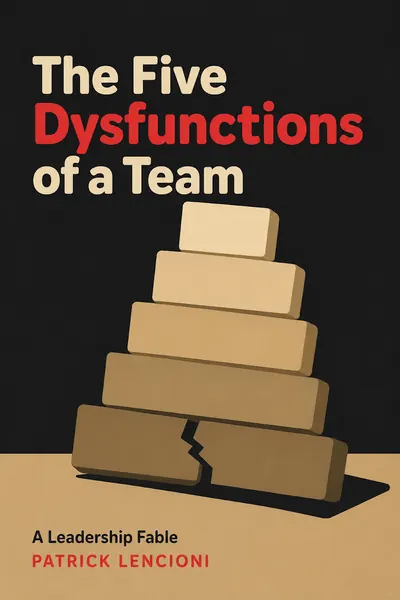
A room full of talented people can still make a poor team. Patrick Lencioni tells the story as a fable about a struggling company, then sets out five problems that stack on top of each other. Fix them from the bottom up.
Hear a sample · read by Laura
The base of Lencioni's pyramid. Without it, everyone acts invulnerable, and their energy goes on protecting themselves instead of the team.
Teams without trust avoid arguing about ideas. Meetings stay polite and dull, and the real debate happens in corridors. Lencioni calls this artificial harmony. Good teams argue openly, even passionately, about the issues, then move on without grudges.
Skip the debate and people nod along in the meeting, then doubt the decision afterwards. Lencioni says most people don't need to get their way. They need to be heard. Once they've argued their case, they can commit to a decision that went against them.
Committed teams hold each other to what they agreed, peer to peer, rather than leaving it all to the boss. At the top of the pyramid sits inattention to results, when people put their own status or their department ahead of what the whole team achieves.
Kathryn
A new CEO, Kathryn Petersen, takes over a clever but broken team at DecisionTech.
Trust
Without trust, people hide their weaknesses and mistakes from each other.
Conflict
Teams that avoid arguing about ideas end up with dull meetings and poor decisions.
Commitment
If people never argue, they never truly agree, so they don't commit to the plan.
Accountability
On a strong team, peers call each other out, so the boss isn't the only one doing it.
A story from the book
DecisionTech has more money and better people than its rivals, and it's falling behind. Its new chief executive, Kathryn Petersen, comes from outside the tech world. She takes her quarrelsome executives on a series of off-sites in Napa, and starts by having each of them talk about their own lives.
One thing to try
At your next team meeting, go round the table. Each person says where they grew up and one challenge from their childhood. It's the first thing Kathryn does in the fable. It takes ten minutes, it's low risk, and colleagues start seeing each other as people.
Knotd has the key ideas from 250+ non-fiction books, each in a few minutes, in plain words. The Five Dysfunctions of a Team comes with a Spot the Trap case and a Your Move story to make it stick.
Get the whole book on KnotdOpen in the appWhy do clever teams fail? A room full of talented people can still make a poor team. Patrick Lencioni tells the story as a fable about a struggling company, then sets out five problems that stack on top of each other. Fix them from the bottom up.
Absence of trust; Fear of conflict; Lack of commitment; Accountability, then results.
At your next team meeting, go round the table. Each person says where they grew up and one challenge from their childhood. It's the first thing Kathryn does in the fable. It takes ten minutes, it's low risk, and colleagues start seeing each other as people.
Yes. Knotd has the key ideas from The Five Dysfunctions of a Team in a few minutes, in plain words, plus a Spot the Trap case and a Your Move story to test them. It's one of 250+ non-fiction books in the app.