
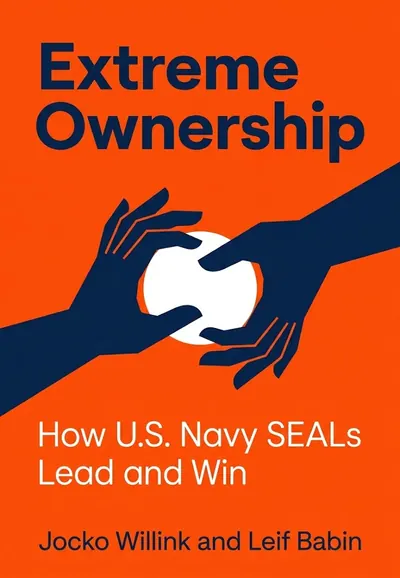
Cover of Extreme Ownership

Leadership

Extreme Ownership

by Jocko Willink and Leif Babin

Who's to blame when it fails?

Jocko Willink and Leif Babin led Navy SEALs through the battle for Ramadi in Iraq. Afterwards they taught the same lessons to companies. Their answer to who is responsible when a team fails is an uncomfortable one. It's the leader, every time.

Hear a sample · read by Laura

0:31

What you'll learn

  • No bad teams
  • Believe it first
  • Check the ego
  • Discipline equals freedom

The key ideas in Extreme Ownership

No bad teams

In SEAL training, boat crews race each other carrying heavy boats. One crew kept winning and another kept coming last. The instructors swapped the two crews' leaders, and the losing crew started winning. Same men, same boat, different leader. The authors say there are no bad teams, only bad leaders.

Believe it first

A leader has to believe in the mission before asking anyone else to. When an order from above seems pointless, the authors' answer is to ask up the chain until you understand why. Then you can explain it to your team, instead of passing it on with a shrug.

Check the ego

Ego is what makes people defend a bad plan, blame another team or wave away advice. Willink and Babin want leaders who are confident and still humble enough to admit a mistake. Taking ownership is impossible if protecting your image matters more than the result.

Discipline equals freedom

Jocko's phrase for the book's last idea. Well-drilled routines and standard procedures give a team room to adapt fast when things go wrong, because nobody has to stop and think about the basics. The same chapter warns that any leadership strength, pushed too far, becomes a weakness.

Lines worth underlining

  1. Own it all

    Whatever goes wrong on your team, the leader owns it. No blaming anyone else.

  2. Bad leaders

    Swap the leaders of a winning crew and a losing one, and the losing crew starts winning.

  3. Believe

    You can't lead people well into a mission you don't believe in yourself.

  4. Cover and move

    Teams on the same side should back each other up, since one team failing sinks the rest.

  5. Simple

    Keep plans simple, because a complicated plan falls apart once things go wrong.

A story from the book

Blue on blue

In Ramadi, confusion once led friendly units to fire on each other. At the debrief, with his bosses looking for someone to blame, Jocko listed everyone's mistakes, then said the fault was his alone, as the commander. It might have cost him his job. Instead, they trusted him more.

One thing to try

Own one problem

Think of one thing going wrong that you've been blaming on someone else. Write down everything you could have done differently, such as how you explained it, planned it or checked on it. Pick one of those and do it this week.

There's more to Extreme Ownership

Knotd has the key ideas from 250+ non-fiction books, each in a few minutes, in plain words. Extreme Ownership comes with a Name That Idea round and a Your Move story to make it stick.

Get the whole book on KnotdOpen in the app

Questions about Extreme Ownership

What is Extreme Ownership about?

Who's to blame when it fails? Jocko Willink and Leif Babin led Navy SEALs through the battle for Ramadi in Iraq. Afterwards they taught the same lessons to companies. Their answer to who is responsible when a team fails is an uncomfortable one. It's the leader, every time.

What are the key ideas in Extreme Ownership?

No bad teams; Believe it first; Check the ego; Discipline equals freedom.

What's one thing to try from Extreme Ownership?

Think of one thing going wrong that you've been blaming on someone else. Write down everything you could have done differently, such as how you explained it, planned it or checked on it. Pick one of those and do it this week.

Is Extreme Ownership on Knotd?

Yes. Knotd has the key ideas from Extreme Ownership in a few minutes, in plain words, plus a Name That Idea round and a Your Move story to test them. It's one of 250+ non-fiction books in the app.