
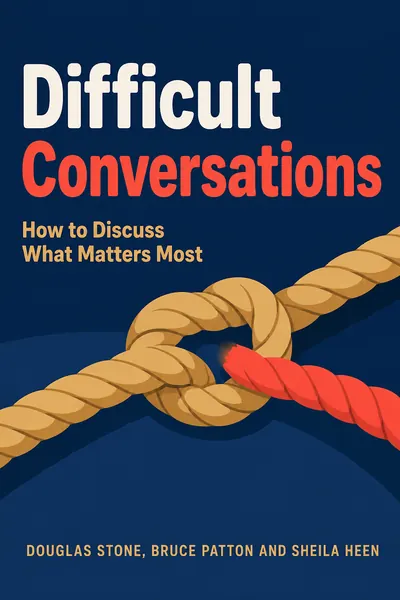
Cover of Difficult Conversations

Communication

Difficult Conversations

by Douglas Stone, Bruce Patton and Sheila Heen

Three talks hiding in one

Douglas Stone, Bruce Patton and Sheila Heen, from the Harvard Negotiation Project, say every difficult conversation is really three at once. We argue about the first and ignore the other two. That's why the same row keeps coming back.

Hear a sample · read by Laura

0:30

What you'll learn

  • The 'What happened?' conversation
  • Intentions aren't impact
  • Swap blame for contribution
  • Feelings and identity
  • Begin from the third story

The key ideas in Difficult Conversations

The 'What happened?' conversation

This is the fight about who's right, who meant what and who's to blame. The authors say it's mostly pointless, because each of you has different information and reads it differently. Instead of arguing, ask why it looks so different from where they stand.
Intentions aren't impact

We assume we know what the other person meant, usually the worst. And we assume our own good intentions cancel out any hurt we caused. The authors ask you to pull the two apart. What they meant is one question. How it landed on you is another.

Swap blame for contribution

Blame asks who's at fault and looks backwards. Contribution asks what each of you did to get here, so you can change it. Owning your part doesn't let them off theirs. It just makes the problem something you can both work on.

Feelings and identity

The second conversation is about feelings. Leave them out and they leak in through tone and sarcasm. The third is about identity, what this says about me. Am I competent? Am I a good person? Am I worthy of love? A hard talk can shake any of them.

Begin from the third story

Open the way a fair mediator would describe the problem, in words you'd both recognise. Then invite them to work it out with you.

Lines worth underlining

  1. Three talks

    Every hard talk is really three: what happened, how we feel, and what it says about who we are.

  2. Their story

    Swap arguing about who's right for curiosity about how each of you sees it.

  3. Intentions

    You know your own intentions but only guess at theirs. Feeling hurt doesn't prove they meant it.

  4. Contribution

    Instead of hunting for someone to blame, ask what each of you did to help create the mess.

  5. Feelings

    Feelings you leave out of the talk leak into it anyway, so name them.

One thing to try

Map the three before you talk

Take a conversation you've been dodging. Write down what happened from their side as well as yours, what you're feeling, and what it threatens in how you see yourself. Then write one opening line from the third story and use it this week.

There's more to Difficult Conversations

Knotd has the key ideas from 250+ non-fiction books, each in a few minutes, in plain words. Difficult Conversations comes with a Your Move story to make it stick.

Get the whole book on KnotdOpen in the app

Questions about Difficult Conversations

What is Difficult Conversations about?

Three talks hiding in one Douglas Stone, Bruce Patton and Sheila Heen, from the Harvard Negotiation Project, say every difficult conversation is really three at once. We argue about the first and ignore the other two. That's why the same row keeps coming back.

What are the key ideas in Difficult Conversations?

The 'What happened?' conversation; Intentions aren't impact; Swap blame for contribution; Feelings and identity; Begin from the third story.

What's one thing to try from Difficult Conversations?

Take a conversation you've been dodging. Write down what happened from their side as well as yours, what you're feeling, and what it threatens in how you see yourself. Then write one opening line from the third story and use it this week.

Is Difficult Conversations on Knotd?

Yes. Knotd has the key ideas from Difficult Conversations in a few minutes, in plain words, plus a Your Move story to test them. It's one of 250+ non-fiction books in the app.