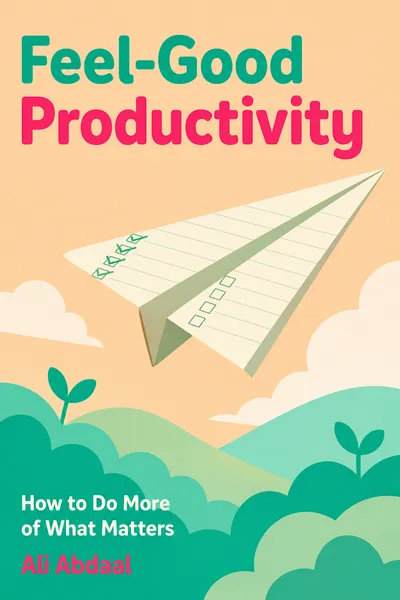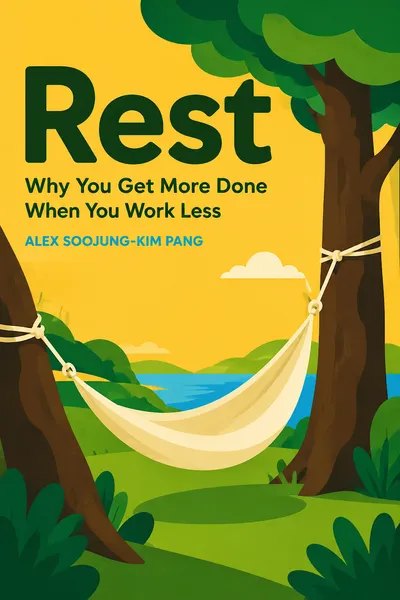
For most professionals, the best productivity books come down to six, and each fixes a different problem: Eat That Frog for putting off the task that matters, Getting Things Done for loose ends crowding your head, Deep Work for focus that won't hold, Essentialism for too many priorities, Four Thousand Weeks for never feeling caught up, and Feel-Good Productivity for getting things done while running on empty. Read the one that matches your problem, not the one at the top of a ranking.
These are productivity books for professionals with full calendars, so each one below comes with the first exercise to try at work tomorrow and a note on who should skip it. The last section maps where the books contradict each other, which is the quickest way to tell which one is yours.
Which of the best productivity books to read first
Find the row that sounds most like your last two weeks, and start there. The second book in each row picks up what the first one leaves open: a fully captured GTD list, for instance, is what the closed list in Four Thousand Weeks is built to tame.
| If this sounds like you | Read first | Then |
|---|---|---|
| One important task keeps sliding to tomorrow | Eat That Frog | The One Thing |
| Your head is full of things you're afraid to forget | Getting Things Done | Four Thousand Weeks |
| You can't stay with hard work for long | Deep Work | Indistractable |
| Everything on your list feels like a priority | Essentialism | The 7 Habits (Habit 3) |
| You never feel caught up, however much you finish | Four Thousand Weeks | Essentialism |
| You get plenty done and still feel drained | Feel-Good Productivity | Rest |
All ten books in the picker are in Knotd, our app, and nine of them sit together in the Productivity hub. Each has a Key Cards deck: you swipe through the book's main ideas one card at a time, and the last card gives you one thing to try. It's a quick way to check that a book fits your problem before you commit to all of it.
If the real obstacle is finding time to read at all, start with how to read more with a full-time job.
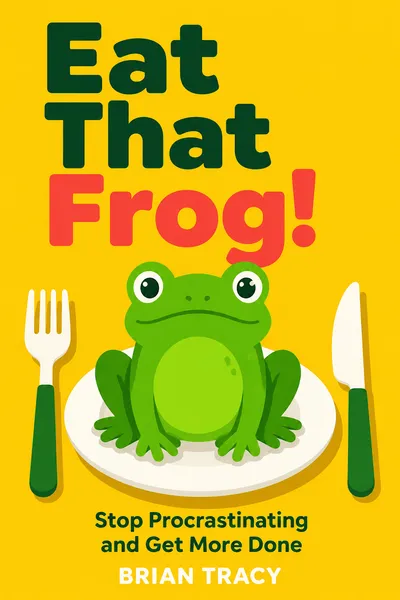
You put off the important thing: Eat That Frog
The problem it fits: one task, usually the one that matters most, moves to tomorrow every day. Brian Tracy builds the book on a saying he credits to Mark Twain: eat a live frog first thing in the morning, and nothing worse will happen to you all day. Your frog is the task you're most likely to avoid.
One idea: Tracy's ABCDE method, in which you label every task. A means serious consequences if it isn't done, B mild ones, C none. D is for delegate and E for eliminate. Then number the As, and never start a B while an A is waiting.
First exercise: tonight, list tomorrow's tasks, label them A to E and number the As. Write A-1 on a sticky note. Tomorrow, start it before you open email and stay with it until it's done.
Skip it if you already do the hard thing first and the trouble is that there are too many hard things (go to Essentialism), or if what you avoid is a daily habit rather than a task; the books in the Habits hub fit that better. Eat That Frog runs on tactics and Tracy's experience more than on studies, and you can finish it in one sitting.
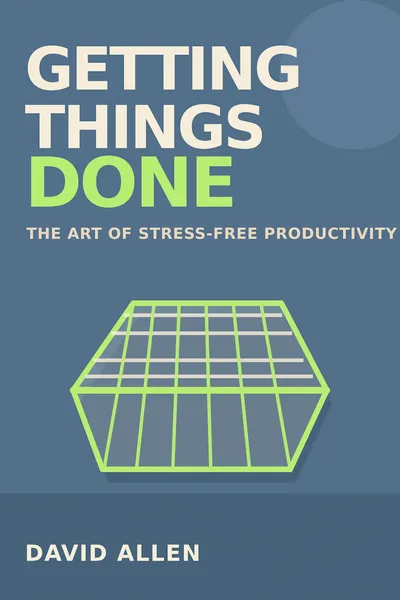
Too many open loops in your head: Getting Things Done
The problem it fits: the passport renewal surfaces in the shower, and an unanswered email surfaces at dinner. David Allen calls each of these an open loop, a commitment with no safe place to live except your memory. The book first came out in 2001 and was rewritten for a 2015 edition.
One idea: five steps, in order: capture everything that has your attention, clarify each item and its very next physical action, organize those actions into lists, reflect on the lists every week, then engage with a clear head. Allen's two-minute rule sits inside the clarify step: if the next action takes less than two minutes, do it on the spot, because tracking it would take longer than doing it.
The evidence: in a series of lab studies by E. J. Masicampo and Roy Baumeister (2011), unfinished goals produced intrusive thoughts during an unrelated reading task and worse scores on an anagram task. Letting people write a specific plan for the goal removed those effects before they had done any of it. These were short lab tasks, not offices, but the finding fits Allen's claim: you quiet a loop by deciding its next step and putting it somewhere you trust, not by finishing it.
First exercise: a mind sweep. Write down everything on your mind, one item per line. Beside each, write the next action. Do the quick ones before bed.
Skip it if your list is short and your trouble is focus or avoidance. GTD has a setup cost. If you've built and dropped systems before, adopt only the mind sweep and the weekly review for a month.
You can't focus for long: two of the best books on focus
Two studies help explain why focus breaks so easily at work. In two experiments, Sophie Leroy (2009) found that when people switched away from an unfinished task, part of their attention stayed behind. She called it attention residue, and performance on the next task suffered. Simply finishing the first task wasn't enough; finishing it under time pressure was what helped people let go.
Gloria Mark, Daniela Gudith and Ulrich Klocke (2008) gave 48 people, mostly German university students with an average age of 26, an email task in a lab, with and without phone or instant-message interruptions. Interrupted people finished faster with no drop in quality, but they rated their stress, frustration, time pressure and effort higher. The authors note it was one short session, so they can't say whether people adapt over time or get worse.
Put together: a quick inbox check in the middle of hard work isn't free, even when the output looks fine. The two books below attack the problem from opposite ends.
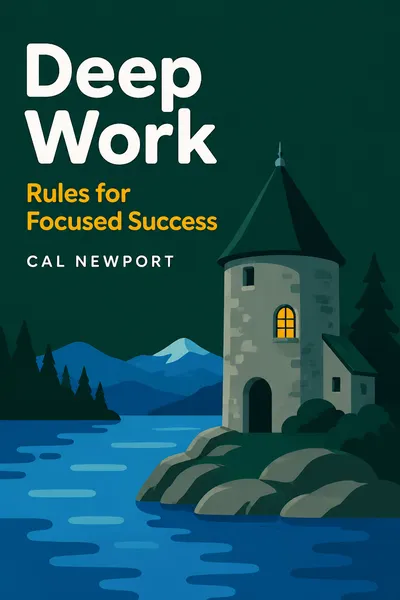
Deep Work (Cal Newport): guard long blocks of focus
It fits if your day is all email and meetings and you never reach the hard thinking your job pays for. Newport splits work into deep and shallow, and he borrows Leroy's attention residue as a reason to stop checking mid-task. He then describes four ways to fit deep work into a life, from cutting out nearly everything to grabbing gaps as they appear.
First exercise: end today with a shutdown ritual. Check email one last time, write a next step for every unfinished task, glance at tomorrow's calendar, then say a set phrase (Newport's is "shutdown complete").
Skip it, or read it second, if the pull comes from your phone rather than your calendar.
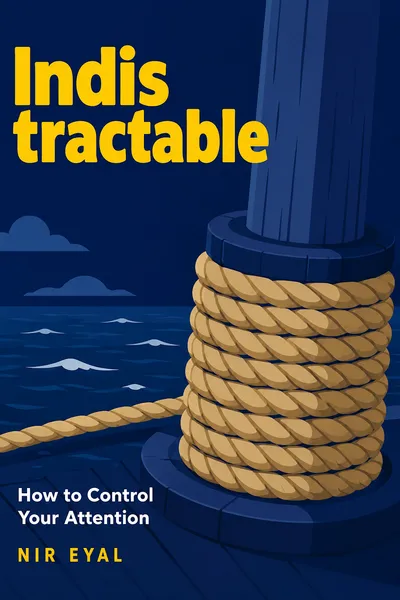
Indistractable (Nir Eyal): notice the urge before you give in
It fits if you reach for your phone the moment work gets hard. Eyal argues that most distraction is an escape from an uncomfortable feeling such as boredom or uncertainty, which he calls an internal trigger.
First exercise: next time you reach for your phone mid-task, write down what you felt just before, then use his ten-minute rule and wait before giving in.
Skip it if your distractions come mostly from how your team works. Eyal covers workplace culture in one part of the book, but most of it is about your own impulses. If the evening scroll is the bigger problem, see how to replace doomscrolling with learning.
Too many priorities: Essentialism, The One Thing and Habit 3
Start with Essentialism, which works on all your commitments at once. The other two apply the same idea to a single day and a single week.
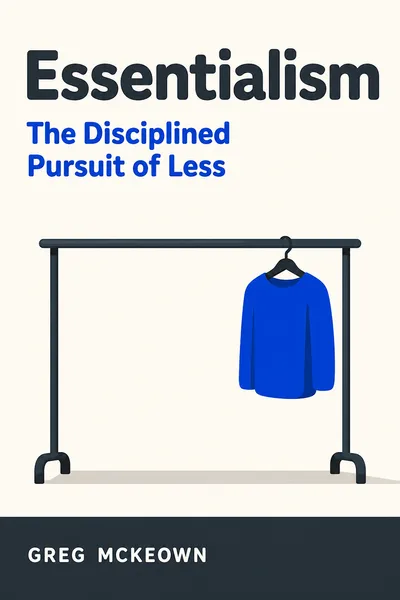
Essentialism (Greg McKeown): cut to the vital few
It fits if you're making a millimeter of progress in a dozen directions. McKeown's motto is "less but better", borrowed from the designer Dieter Rams. His 90 percent rule: judge an option against the one criterion that matters most, and treat any score under 90 as a zero.
First exercise: list your regular commitments, and for each ask the reverse question: if I weren't already doing this, how hard would I work to start? Step back from one this week.
Skip it if you already say no easily and your trouble is following through on one clear priority.
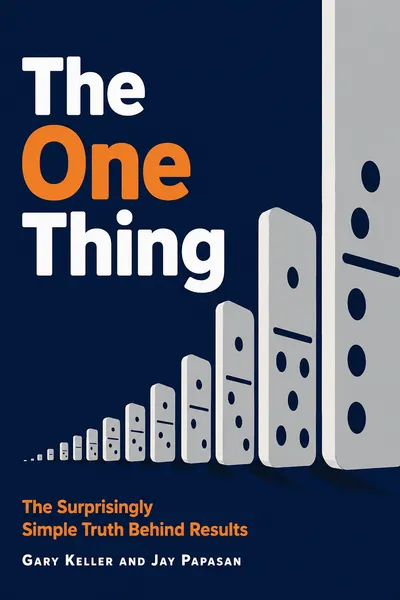
The One Thing (Gary Keller and Jay Papasan): one question a day
This book narrows the same idea to a single daily question: what one thing could you do that would make everything else easier or unnecessary? They tell you to block time for the answer early in the day, before anything else claims it.
First exercise: tomorrow, write the question at the top of a page before you open your inbox, answer it, and book the first stretch of your morning for that answer.
Skip it if you've read Essentialism and agreed with it; the two overlap heavily, and this is the narrower book.
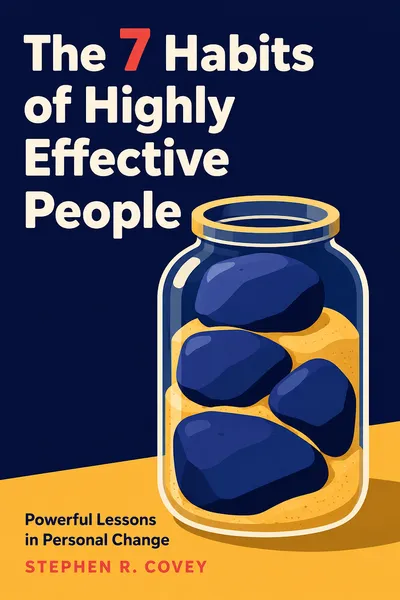
The 7 Habits of Highly Effective People (Stephen R. Covey): the important-not-urgent quadrant
Covey wrote a book about character, and only Habit 3, Put First Things First, is about time. Covey sorts tasks by urgent and important. He argues that effective people spend more time in Quadrant II, the important but not urgent, such as planning, prevention, relationship building and recreation. Neglect it, and it comes back as Quadrant I crises.
First exercise: on Sunday, list your roles (manager and partner, for example), pick one Quadrant II goal for each, and put those in the calendar first.
Skip the rest if you only want time advice; read Habit 3 alone.
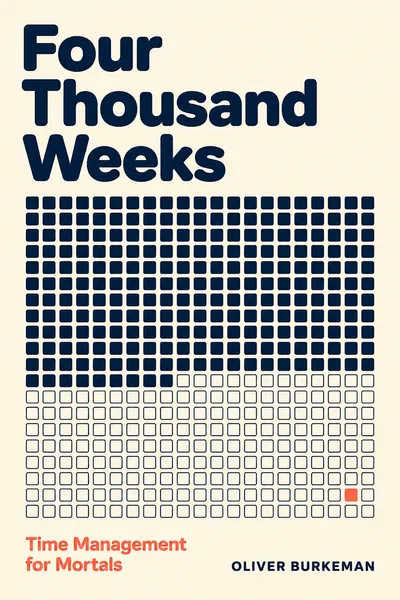
There's never enough time: Four Thousand Weeks
Oliver Burkeman's complaint about most of the best books on time management is that they promise you'll get on top of everything with the right system. Burkeman, who calls himself a former productivity geek, argues you never will, and that chasing the promise makes the problem worse. If you live to 80, you get about four thousand weeks.
One idea: the efficiency trap. Reply to email faster and more email comes back. Getting better at getting through things mostly brings more things to get through. His answer is to decide in advance what to fail at: pick one or two areas to throw yourself into for now, and let others slide without the guilt.
First exercise: split your to-do list in two. The open list can grow as long as it likes. The closed list holds no more than ten items, and nothing joins it until something leaves. Work only from the closed list this week.
Skip it if you need a method for clearing this week's backlog. Burkeman argues more than he instructs, and the system books above give more structure.
Productive but drained: Feel-Good Productivity and Rest
Both books treat energy, not hours, as the thing to manage. Read Feel-Good Productivity first if the work itself feels heavy, and Rest first if you never properly stop.
Feel-Good Productivity (Ali Abdaal): make the work feel better first
It fits if you get things done by grinding and the grind is wearing thin. The book grew out of Abdaal's years as a junior doctor with a YouTube channel on the side. His argument is that feeling good comes first and makes the work easier, rather than arriving as a reward at the end. He names play, power and people as the things that lift energy, and he prefers goals that are near-term, input-based, controllable and energizing.
First exercise: take a task you've been dreading, ask what it would look like if it were fun, and change one thing about it: do it with a friend, or race a timer.
Skip it if you like your work and the trouble is sheer volume.
Rest (Alex Soojung-Kim Pang): plan your breaks like work
It fits if you treat rest as whatever is left after work. Pang points to many famously productive scientists and writers who did only about four hours of hard, focused work a day. Charles Darwin, for one, worked in short sessions and walked a gravel loop he called his thinking path. Ernest Hemingway stopped writing each day while he still knew what came next.
First exercise: this afternoon, stop your main task at a point where you know the next step, write it on a sticky note, and take a walk without your phone.
Skip it if you have little say over your hours; most of Pang's examples set their own schedules.
A newer book Knotd doesn't carry: Slow Productivity
Cal Newport's Slow Productivity (Portfolio, March 2024) belongs on this list, and Knotd doesn't carry it. According to its publisher's page, it rests on three principles: do fewer things, work at a natural pace, and obsess over quality. Deep Work protects focus inside a working day; Slow Productivity steps back to the size and pace of your workload across months and seasons. It suits knowledge workers who are busy all the time and want room for their best work, and it sits well next to Rest and Four Thousand Weeks.
Where these books disagree
These books contradict each other, and the contradictions are the quickest way to tell which one is yours.
| Question | Book A says | Book B says | Try this if… |
|---|---|---|---|
| Should everything go on a list? | Getting Things Done: capture every commitment in a trusted system | Essentialism: cut most commitments before they reach a list | A if things slip through the cracks; B if the list is accurate but too long |
| Should every hour have a job? | Deep Work: plan the whole workday in blocks, and redo the plan when it breaks | Rest: a few hours of hard focus, then walks and real breaks | A if other people eat your day; B if you sit at a desk all day and still fall behind |
| Is the goal to get more done? | Eat That Frog: do the important tasks first and output rises | Four Thousand Weeks: doing more mostly brings more to do | A if you avoid the work; B if you do the work and never feel finished |
| Where does distraction start? | Deep Work: train focus and cut the tools that break it up | Indistractable: start with the feeling you're escaping | A if work itself is fragmented; B if you interrupt yourself |
| Discipline or mood first? | Eat That Frog: start the hard task whatever you feel | Feel-Good Productivity: make the task feel better and starting gets easier | A if you stall for a day at a time; B if you start fine but run out of energy |
Neither side is wrong. Each book was written for a different kind of stuck, which is why a book that changed a colleague's year can do nothing for yours.
A two-week test keeps you honest:
- Pick the one row in the picker at the top that stings most.
- Read that book, or its key ideas, and do its first exercise tomorrow.
- Repeat the exercise every workday for two weeks before you add a second book.
- If it doesn't stick, find your row in the table above. You may need the book on the other side.