
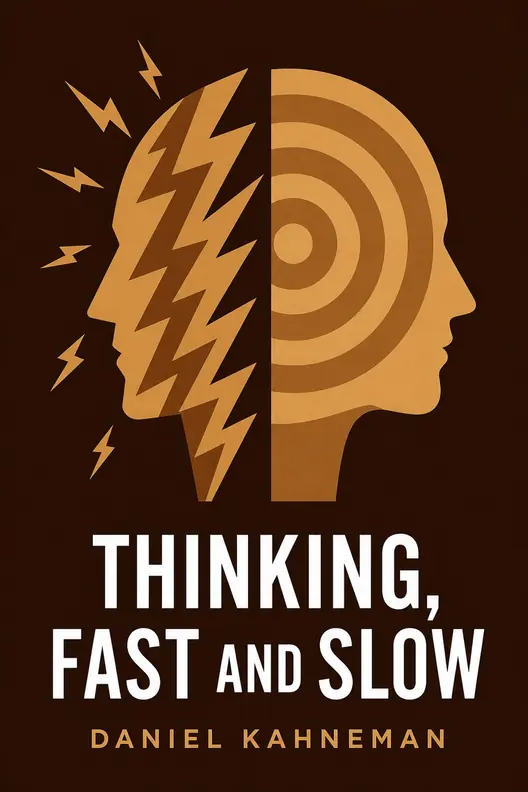
Cover of Thinking, Fast and Slow

Finance

Thinking, Fast and Slow

by Daniel Kahneman

Who's really making your choices?

You feel like the one who weighs things up and decides. Daniel Kahneman, a psychologist who won the Nobel Prize in economics, argues that a faster, quieter part of your mind has usually decided already. The careful part of you mostly signs off on its answer.

Hear a sample · read by Laura

0:30

What you'll learn

  • System 1 and System 2
  • What you see is all there is
  • Losses loom larger than gains
  • The remembering self

The key ideas in Thinking, Fast and Slow

System 1 and System 2

Kahneman pictures two characters in your mind. System 1 is fast and automatic. It spots anger in a face and knows 2 + 2 instantly. System 2 is slow and effortful, the one you need for 17 × 24. System 2 believes it's in charge. Mostly, it isn't.
What you see is all there is

System 1 builds the neatest story it can from whatever is in front of it, and never asks what's missing. Kahneman shortens this to WYSIATI. It's why people who hear only one side of an argument feel more sure, even when they know it's one-sided.

Losses loom larger than gains

Kahneman offers a bet. If a coin lands tails you lose $100, and if it lands heads you win $150. Most people refuse, although the odds favour them. A loss hurts more than an equal win pleases. This loss aversion is central to prospect theory, his work with Amos Tversky.

The remembering self

Kahneman splits you in two. The experiencing self lives through each moment, and the remembering self keeps score afterwards. In a study of colonoscopies, patients judged the ordeal by its worst moment and how it ended, and not by its length. The remembering self chooses what you do next.

Lines worth underlining

  1. Two systems

    Most of your thinking is fast and automatic. The slow, careful kind is lazy and rarely steps in.

  2. Jumping ahead

    We jump to conclusions from the little we can see, and don't notice what's missing.

  3. Anchors

    Any number you hear first, even a random one, pulls your guess towards it.

  4. Planning

    We plan for the best case and forget how long such projects usually take.

  5. Loss aversion

    Losing something hurts about twice as much as gaining it feels good.

A story from the book

The bat and the ball

A bat and a ball cost $1.10. The bat costs a dollar more than the ball. How much is the ball? Ten cents jumps to mind, and it's wrong. It's five cents. Kahneman reports that over half the students at Harvard, MIT and Princeton gave the quick answer.

One thing to try

Run a premortem

Pick a plan you'll commit to soon, like a house move or a new hire. Imagine it's a year later and it failed badly. Spend five minutes writing the story of how. Kahneman borrowed this premortem from Gary Klein. It surfaces doubts while changing course is still cheap.

There's more to Thinking, Fast and Slow

Knotd has the key ideas from 250+ non-fiction books, each in a few minutes, in plain words. Thinking, Fast and Slow comes with a Name That Idea round and a Spot the Trap case to make it stick.

Get the whole book on KnotdOpen in the app

Questions about Thinking, Fast and Slow

What is Thinking, Fast and Slow about?

Who's really making your choices? You feel like the one who weighs things up and decides. Daniel Kahneman, a psychologist who won the Nobel Prize in economics, argues that a faster, quieter part of your mind has usually decided already. The careful part of you mostly signs off on its answer.

What are the key ideas in Thinking, Fast and Slow?

System 1 and System 2; What you see is all there is; Losses loom larger than gains; The remembering self.

What's one thing to try from Thinking, Fast and Slow?

Pick a plan you'll commit to soon, like a house move or a new hire. Imagine it's a year later and it failed badly. Spend five minutes writing the story of how. Kahneman borrowed this premortem from Gary Klein. It surfaces doubts while changing course is still cheap.

Is Thinking, Fast and Slow on Knotd?

Yes. Knotd has the key ideas from Thinking, Fast and Slow in a few minutes, in plain words, plus a Name That Idea round and a Spot the Trap case to test them. It's one of 250+ non-fiction books in the app.