
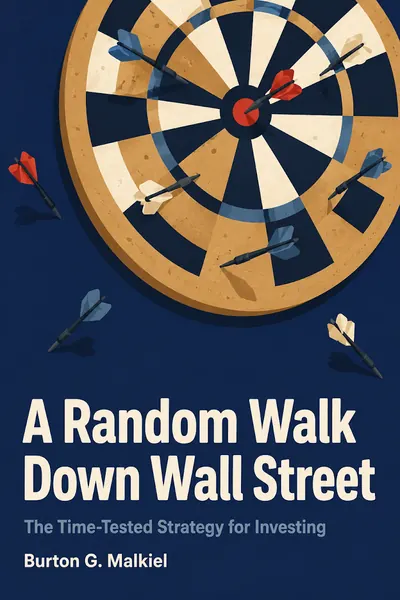
Cover of A Random Walk Down Wall Street

Finance

A Random Walk Down Wall Street

by Burton G. Malkiel

Can anyone beat the market?

Burton Malkiel, a Princeton economist, asks whether stock pickers, chart readers and fund managers can reliably do better than the stock market as a whole. His answer, first published in 1973 and updated in every edition since, is that hardly anyone manages it for long.

Hear a sample · read by Laura

0:24

What you'll learn

  • A random walk
  • Two theories of value
  • The pros rarely win
  • Invest for your age

The key ideas in A Random Walk Down Wall Street

A random walk

Malkiel's title means that short-term share prices move unpredictably. News arrives at random and prices adjust to it fast, so yesterday's chart says almost nothing about tomorrow. Taken to the extreme, a blindfolded monkey throwing darts at the share pages could pick as well as the experts.
Two theories of value

Malkiel sets out two ways to value a share. The firm-foundation theory says it's worth the earnings and dividends it will pay in future. The castle-in-the-air theory, which he traces to Keynes, says it's worth whatever someone else will pay for it. Bubbles are built on castles.

The pros rarely win

Year after year, most actively managed funds do worse than an index fund that simply owns the whole market, once fees are counted. And this year's star fund is rarely next decade's. Malkiel finds little evidence that past performance predicts future results.

Invest for your age

How much you hold in shares should depend mainly on your stage of life. A 25-year-old can ride out crashes and hold mostly shares. Someone close to retirement needs more in bonds. Malkiel also wants a cash reserve for emergencies, and a fixed sum invested regularly.

Lines worth underlining

  1. Random walk

    Share prices move so unpredictably that yesterday's moves tell you almost nothing about tomorrow's.

  2. Bubbles

    Crowds build castles in the air, from Dutch tulips to dot-com shares, and they always come down.

  3. Charts

    Reading charts to predict prices works no better than chance once you count the trading costs.

  4. Fund managers

    Most professional fund managers fail to beat the market over time. A cheap index fund usually wins.

  5. Risk

    Higher returns come only with more risk. How much you take should fit your age and nerves.

A story from the book

The tronics boom

Malkiel describes the early 1960s, when almost any company with 'tronics' in its name could sell new shares at a sky-high price. In the late 1990s the magic word became '.com'. Both times the technology was real, and the people who bought at the peak still lost money.

Hot take · true or myth?

Most professional fund managers beat the market average.

See the book's answer

Myth. Most actively managed funds do worse than a low-cost index fund over long periods. Their fees and trading costs eat whatever edge their research gives them.

One thing to try

Check what you pay

Look up the annual charge on every fund you hold, including your pension. Malkiel's advice for most savers is a broad, low-cost index fund. If you're paying more for active management, ask what the extra has bought you over the last ten years.

There's more to A Random Walk Down Wall Street

Knotd has the key ideas from 250+ non-fiction books, each in a few minutes, in plain words. A Random Walk Down Wall Street comes with a Hot Take round to make it stick.

Get the whole book on KnotdOpen in the app

Questions about A Random Walk Down Wall Street

What is A Random Walk Down Wall Street about?

Can anyone beat the market? Burton Malkiel, a Princeton economist, asks whether stock pickers, chart readers and fund managers can reliably do better than the stock market as a whole. His answer, first published in 1973 and updated in every edition since, is that hardly anyone manages it for long.

What are the key ideas in A Random Walk Down Wall Street?

A random walk; Two theories of value; The pros rarely win; Invest for your age.

What's one thing to try from A Random Walk Down Wall Street?

Look up the annual charge on every fund you hold, including your pension. Malkiel's advice for most savers is a broad, low-cost index fund. If you're paying more for active management, ask what the extra has bought you over the last ten years.

Is A Random Walk Down Wall Street on Knotd?

Yes. Knotd has the key ideas from A Random Walk Down Wall Street in a few minutes, in plain words, plus a Hot Take round to test them. It's one of 250+ non-fiction books in the app.