Learning is the progress
In that fog, lines of code and launch dates prove little. What counts is validated learning, something you've shown to be true about customers by testing it.
Business
by Eric Ries
Why do well-run startups fail?
Eric Ries saw startups hit every deadline in their plan and still build something nobody wanted. He calls this achieving failure, carrying out a plan perfectly when the plan itself was wrong. The Lean Startup is his method for finding out much sooner.
Hear a sample · read by Laura
In that fog, lines of code and launch dates prove little. What counts is validated learning, something you've shown to be true about customers by testing it.
Every plan rests on a few guesses that everything else depends on. Ries picks out two. The value hypothesis asks whether people really get something out of the product. The growth hypothesis asks how new customers will find it. Test these before anything else.
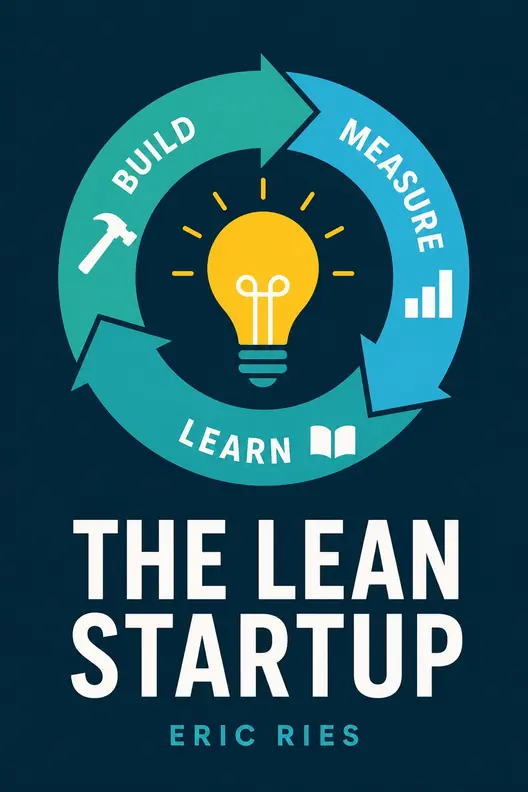
Turn an idea into something customers can use, measure how they respond, and learn whether to change course or carry on. Ries wants teams going round this loop as fast as they can. He plans it backwards, starting with what you most need to learn.
An MVP is the smallest thing that lets you start learning. To see if people would buy shoes online, Zappos founder Nick Swinmurn photographed shoes in local shops and put the pictures on a website. When an order came in, he bought the pair at full price and posted it.
Uncertainty
A startup is people making something new while nobody knows yet if it will work.
Learning
Real progress means learning what customers want, proved with real data.
MVP
Ship a minimum viable product, the smallest thing that tests your idea on real people.
The loop
Speed up the build-measure-learn loop, so each round teaches you something sooner.
Vanity
Ignore vanity metrics like total sign-ups. Watch the numbers that show real behaviour.
A story from the book
At Ries's company IMVU, the team spent months building 3D avatars as an add-on to existing chat apps, so people could bring their friends along. Hardly anyone downloaded it. When they finally sat customers down, people said they didn't want to invite friends until they knew it was any good.
One thing to try
Write down the one assumption your idea can't survive being wrong about. Then find the cheapest way to test it before Friday. A sign-up page, a handwritten flyer, or doing the service by hand for one customer will all tell you something real.
Knotd has the key ideas from 250+ non-fiction books, each in a few minutes, in plain words. The Lean Startup comes with a Name That Idea round to make it stick.
Get the whole book on KnotdOpen in the appWhy do well-run startups fail? Eric Ries saw startups hit every deadline in their plan and still build something nobody wanted. He calls this achieving failure, carrying out a plan perfectly when the plan itself was wrong. The Lean Startup is his method for finding out much sooner.
Learning is the progress; Leap-of-faith assumptions; Build, measure, learn; The minimum viable product.
Write down the one assumption your idea can't survive being wrong about. Then find the cheapest way to test it before Friday. A sign-up page, a handwritten flyer, or doing the service by hand for one customer will all tell you something real.
Yes. Knotd has the key ideas from The Lean Startup in a few minutes, in plain words, plus a Name That Idea round to test them. It's one of 250+ non-fiction books in the app.