
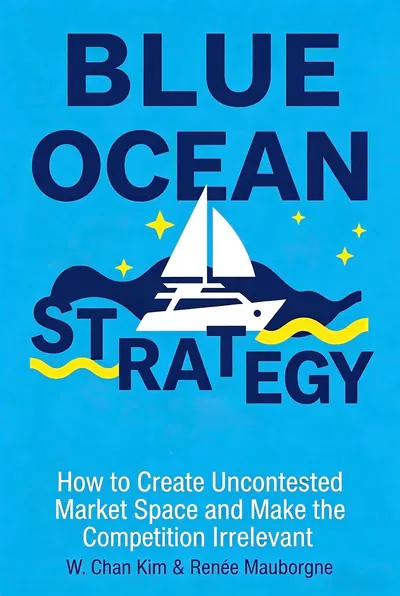
Cover of Blue Ocean Strategy

Product and Customer Development

Blue Ocean Strategy

by W. Chan Kim & Renée Mauborgne

Why fight over the same customers?

W. Chan Kim and Renée Mauborgne, professors at INSEAD, studied 150 strategic moves across more than a hundred years and thirty industries. The companies that pulled ahead had mostly stopped fighting rivals head-on. They made new markets where there was nobody to fight yet.

What you'll learn

  • Red oceans and blue oceans
  • Value innovation
  • The four actions
  • The strategy canvas

The key ideas in Blue Ocean Strategy

Red oceans and blue oceans

Red oceans are the industries that exist today. Everyone knows the rules and fights over the same demand, until profits shrink and the water turns bloody. Blue oceans are markets nobody serves yet. There, the authors argue, competition is irrelevant, because the rules haven't been written.
Value innovation

The authors call this the cornerstone. Most companies pick between offering more at a higher cost or less at a lower cost. Value innovation does both at once. You cut costs by dropping what buyers don't really value, and add what they've never been offered.

The four actions

Kim and Mauborgne's four questions for a new offer. Which factors that your industry takes for granted can you eliminate? What can you reduce well below the standard? What should you raise well above it? What can you create that the industry has never offered?

The strategy canvas

List the factors your industry competes on along the bottom of a chart, and score how much each company offers on each. Join the dots and you get each player's value curve. If your curve looks like everyone else's, you're swimming in a red ocean.

Lines worth underlining

  1. Red oceans

    Competing head to head in a crowded market leaves everyone fighting over less.

  2. Blue oceans

    The better move is to create a market nobody is in yet, so rivals stop mattering.

  3. Value innovation

    Aim to be different and cheaper at the same time, by cutting what buyers don't value.

  4. Cirque du Soleil

    Cirque du Soleil dropped the animals and star acts, then borrowed story and art from theatre.

  5. Four actions

    Ask what to cut, what to reduce, what to raise and what to create that nobody offers.

A story from the book

A circus without animals

Circuses were in decline. Children preferred video games, and star performers and animals were getting more expensive. Cirque du Soleil dropped both. It kept the tent, clowns and acrobats, and borrowed a storyline, artistic music and dance from theatre. Adults and corporate clients paid theatre prices to see it.

Hot take · true or myth?

Looking at industries you don't compete in can give you your best idea.

See the book's answer

True. NetJets looked at two alternatives, flying first or business class and owning a corporate jet, and combined their strengths into fractional ownership of private jets.

One thing to try

Draw your own canvas

Take your business, or your team's service. List six to eight things your industry competes on, and score yourself and two rivals from low to high. Then pick one factor you could eliminate and one you could create.

There's more to Blue Ocean Strategy

Knotd has the key ideas from 250+ non-fiction books, each in a few minutes, in plain words. Blue Ocean Strategy comes with a Hot Take round and a Name That Idea round to make it stick.

Get the whole book on KnotdOpen in the app

Questions about Blue Ocean Strategy

What is Blue Ocean Strategy about?

Why fight over the same customers? W. Chan Kim and Renée Mauborgne, professors at INSEAD, studied 150 strategic moves across more than a hundred years and thirty industries. The companies that pulled ahead had mostly stopped fighting rivals head-on. They made new markets where there was nobody to fight yet.

What are the key ideas in Blue Ocean Strategy?

Red oceans and blue oceans; Value innovation; The four actions; The strategy canvas.

What's one thing to try from Blue Ocean Strategy?

Take your business, or your team's service. List six to eight things your industry competes on, and score yourself and two rivals from low to high. Then pick one factor you could eliminate and one you could create.

Is Blue Ocean Strategy on Knotd?

Yes. Knotd has the key ideas from Blue Ocean Strategy in a few minutes, in plain words, plus a Hot Take round and a Name That Idea round to test them. It's one of 250+ non-fiction books in the app.